"FORM FOLLOWS FUNCTION" OR: WE WERE NOT BORN PREDICTABLE
"Form follows function" is one of those lines that has been repeated so often in design that it feels timeless. Louis Sullivan wrote it in 1896 about architecture: buildings, he thought, should express what they're for. Since then, the phrase has slipped from its original context and settled into modernism – and later into the language of corporate design.
The idea sounds reasonable enough: let purpose lead and keep decoration secondary. But "function" isn't a neutral word. Someone always decides what counts as the function, and that decision serves a particular set of interests.
In the industrial era, "function" was tightly bound up with efficiency and mass production. Machines were built to regulate output and keep workers on tempo. Modernist designers took on a similar project: design could streamline human activity by stripping away what seemed "unnecessary", and in turn make life run more smoothly. That ideal fits neatly with industrial capitalism, which depends on people being relatively predictable.
James C. Scott's idea of "legibility" in Seeing Like a State (1998) offers an interesting lens through which to view this. Scott argues that centralized powers, like states and markets, have always tried to make messy, lived realities easier to see from above. This drive for simplification shows up in things like agricultural reforms, urban grids and even surnames, all designed to make societies easier to manage.
When we apply Scott’s idea to design, "form follows function" stops looking human-centered. A design stripped of complexity might at first glance seem to serve the user, while in reality it caters to the system that monitors and steers the user's behavior.
Ecommerce is a good example of this dynamic pushed very far. Frictionless interfaces, with features like one-click checkouts and stored credit cards, reduce hesitation and drive conversions. As everything becomes more "functional", the system, not the user, reaps the benefits.
Marshall McLuhan's line that "the medium is the message" adds another twist. In Understanding Media, he argues that the structure of a medium shapes us more than the specific messages it carries. The standard ecommerce pattern with a "Buy Now" button front and center conditions people to act quickly and repeatedly. Over time, that environment trains a certain kind of reflex – and we're often less in control of our decisions than we realize.
Read together, Scott and McLuhan suggest a less innocent reading of "form follows function" – the key issue being who defines "function" and which rationality it encodes. Pushing back on the mantra means reconsidering common design practices (look towards HCI and design research, where resistance is created through critical form and federated platforms) and making space for ambiguity and outcomes that cannot be fully predicted.
"FORM FOLLOWS FUNCTION" OR: WE WERE NOT BORN PREDICTABLE
"Form follows function" is one of those lines that has been repeated so often in design that it feels timeless. Louis Sullivan wrote it in 1896 about architecture: buildings, he thought, should express what they're for. Since then, the phrase has slipped from its original context and settled into modernism – and later into the language of corporate design.
The idea sounds reasonable enough: let purpose lead and keep decoration secondary. But "function" isn't a neutral word. Someone always decides what counts as the function, and that decision serves a particular set of interests.
In the industrial era, "function" was tightly bound up with efficiency and mass production. Machines were built to regulate output and keep workers on tempo. Modernist designers took on a similar project: design could streamline human activity by stripping away what seemed "unnecessary", and in turn make life run more smoothly. That ideal fits neatly with industrial capitalism, which depends on people being relatively predictable.
James C. Scott's idea of "legibility" in Seeing Like a State (1998) offers an interesting lens through which to view this. Scott argues that centralized powers, like states and markets, have always tried to make messy, lived realities easier to see from above. This drive for simplification shows up in things like agricultural reforms, urban grids and even surnames, all designed to make societies easier to manage.
When we apply Scott’s idea to design, "form follows function" stops looking human-centered. A design stripped of complexity might at first glance seem to serve the user, while in reality it caters to the system that monitors and steers the user's behavior.
Ecommerce is a good example of this dynamic pushed very far. Frictionless interfaces, with features like one-click checkouts and stored credit cards, reduce hesitation and drive conversions. As everything becomes more "functional", the system, not the user, reaps the benefits.
Marshall McLuhan's line that "the medium is the message" adds another twist. In Understanding Media, he argues that the structure of a medium shapes us more than the specific messages it carries. The standard ecommerce pattern with a "Buy Now" button front and center conditions people to act quickly and repeatedly. Over time, that environment trains a certain kind of reflex – and we're often less in control of our decisions than we realize.
Read together, Scott and McLuhan suggest a less innocent reading of "form follows function" – the key issue being who defines "function" and which rationality it encodes. Pushing back on the mantra means reconsidering common design practices (look towards HCI and design research, where resistance is created through critical form and federated platforms) and making space for ambiguity and outcomes that cannot be fully predicted.
© 2026 Studio Dim | info@studio-dim.com
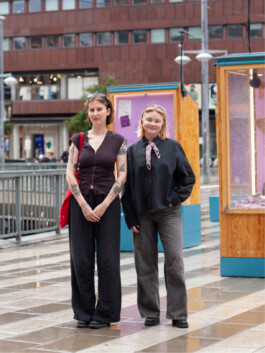
Studio Dim is a creative practice for communication, design and art run by Ida Dimić and Henrietta Andersson. Currently based between Stockholm and Berlin.
We want to use our expertise to support people and groups focused on social justice, cultural change and community.
Recent projects include a campaign for Sweden's largest democratic arena, curation and exhibition design for a queer museum and a new website for an indie cinema.
If you're working on something you care about, we'd love to hear from you at hi@studio-dim.com
Follow us: @studio__dim

Studio Dim is a creative practice for communication, design and art run by Ida Dimić and Henrietta Andersson. Currently based between Stockholm and Berlin.
We want to use our expertise to support people and groups focused on social justice, cultural change and community.
Recent projects include a campaign for Sweden's largest democratic arena, curation and exhibition design for a queer museum and a new website for an indie cinema.
If you're working on something you care about, we'd love to hear from you at hi@studio-dim.com
Follow us: @studio__dim
